
I-Lead Leadership Development Program
Leadership Journey Designed for Real Manager Transitions
Four distinct leadership journeys built around real managerial transitions, combining behavioral science, mindset transformation, and practical leadership capability.
Leadership development is rarely a linear progression. Organizations evolve at different speeds, and managers encounter distinct challenges as responsibilities expand. The iLead program is built around recurring managerial transitions observed across industries, recognizing that effective leadership growth requires more than skill acquisition, it requires shifts in how leaders think, interpret situations, and influence outcomes.
Each iLead journey addresses both visible capability gaps and the deeper psychological transitions that shape decision-making, accountability, and leadership behavior. Grounded in behavioral science and organizational psychology, the program enables managers to move from reactive execution toward intentional, context-aware leadership.





The Four Leadership Journey

High Potentials
This journey supports high-performing individual contributors transitioning toward leadership responsibility. At this stage, success is typically driven by expertise and personal achievement.
The developmental shift involves expanding perspective moving:
- From task completion to outcome ownership
- From individual performance to collective impact
- From execution focus to leadership judgment
Participants develop stakeholder awareness, influence without authority, and early decision-making capability while building the growth mindset required for future leadership transitions.
First Time Managers
The move into people management represents one of the most significant psychological shifts in a professional career. Managers must redefine their value from delivering results personally to enabling results through others.
Common challenges include:
- Difficulty delegating
- Over-involvement in execution
- Unclear accountability structures
- Decision fatigue and cognitive overload
This journey builds trust-based delegation, structured communication practices, and clear accountability systems that allow managers to lead effectively without reverting to individual contributor behaviors.
Experienced Managers
As managerial scope expands, leaders must balance operational delivery with long-term team development while navigating multiple stakeholder expectations.
At this stage, leadership effectiveness depends on:
- Emotional regulation under pressure
- Strategic prioritization
- Developmental conversations
- Performance accountability
This journey integrates psychological safety principles and behavioral feedback frameworks to help managers create environments where teams take ownership and execute with clarity.
Manager's Manager
Leaders managing other managers operate at a systemic level. Impact is no longer created through direct control but through alignment, context-setting, and capability building.
The psychological transition involves shifting:
- From problem-solving to environment shaping
- From managing tasks to enabling leadership capability
- From operational oversight to strategic direction
This journey focuses on strategic thinking, decision-making under ambiguity, and leadership multiplication enabling organizations to build scalable leadership pipelines.
I Lead Journey Map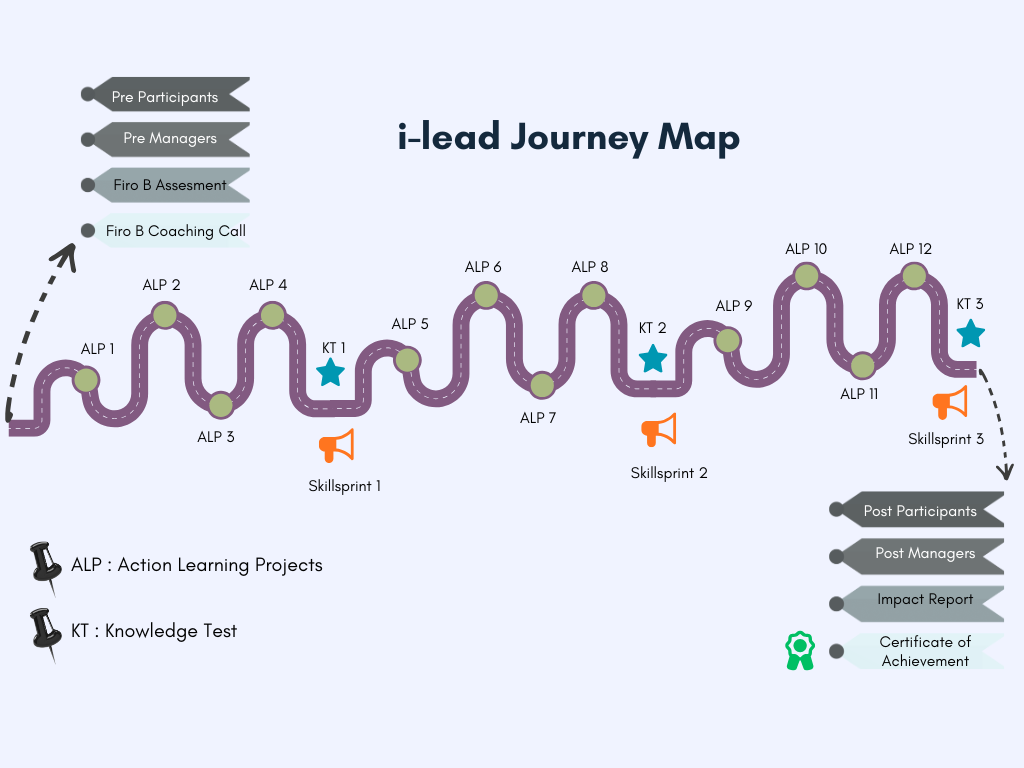
Ratings & Reviews
5 /5
1 ratings
●
1 reviews
5
4
3
2
1
By clicking on Continue, I accept the Terms & Conditions,
Privacy Policy